
With No Bears Bill Sent to Governor Before Adjournment, Owners Announce They’re Moving Forward in Indiana

I was hopeful when I learned a simplified proposal would be coming forward in the final hours of session that would aim to keep the Chicago Bears in Illinois.
From the very beginning, I was clear that I wanted the Chicago Bears to stay in Illinois, but that I would not support a proposal that could lead to tax increases for Illinoisans. Unfortunately, the proposal that was brought before the Senate included a provision that would allow a locally created stadium authority to issue bonds that would be paid for by taxpayers. It was also hastily put together, did not go before a committee for vetting, and included so many errors it had to be amended before coming to the floor at 3:30 AM.
The measure ended up passing in the Senate, but it was not called for a vote in the House.
On Friday, the Chicago Bears organization announced it will advance its stadium development in Hammond, Indiana. Upon learning the news, I issued the following statement:
“Today’s announcement that the Chicago Bears will move forward with their stadium development project in Hammond, Indiana is deeply disappointing. Unfortunately, this outcome is the direct result of a process that was marked by dysfunction, delay, and a complete lack of leadership from Governor JB Pritzker. The General Assembly had ample time to evaluate options and negotiate a responsible plan that could keep the Bears in Illinois while protecting taxpayers. Instead, lawmakers were presented with a hastily assembled proposal in the final hours of session and expected to vote on it without it being vetted by a committee and without enough time to really read it and understand its provisions.
“A proposal of this magnitude should have gone through committee hearings, received thorough vetting, and included clear and enforceable protections for taxpayers. Instead, the legislation was rushed through the process, required an amendment to fix sloppy errors, and failed to provide the safeguards many of us believed were essential.
“When one of Illinois’ most important economic assets was weighing its future, state leadership should have been fully engaged and working toward a serious solution. Instead, indecision and political maneuvering became the defining characteristics of this effort.
“I remain hopeful that this announcement is not the final chapter and that discussions can continue. However, if the Bears ultimately leave Illinois, it will stand as a stark example of what happens when the Governor fails to lead, major decisions are rushed through at the eleventh hour, and taxpayers are asked to accept a deal without the protections they deserve.”
After Eight Years of Pritzker, Illinois Families Continue to Pay More
During the overnight hours of May 31/June 1, Democrats pushed through the largest budget in state history, continuing a trend of significant spending increases during Governor JB Pritzker’s time in office.
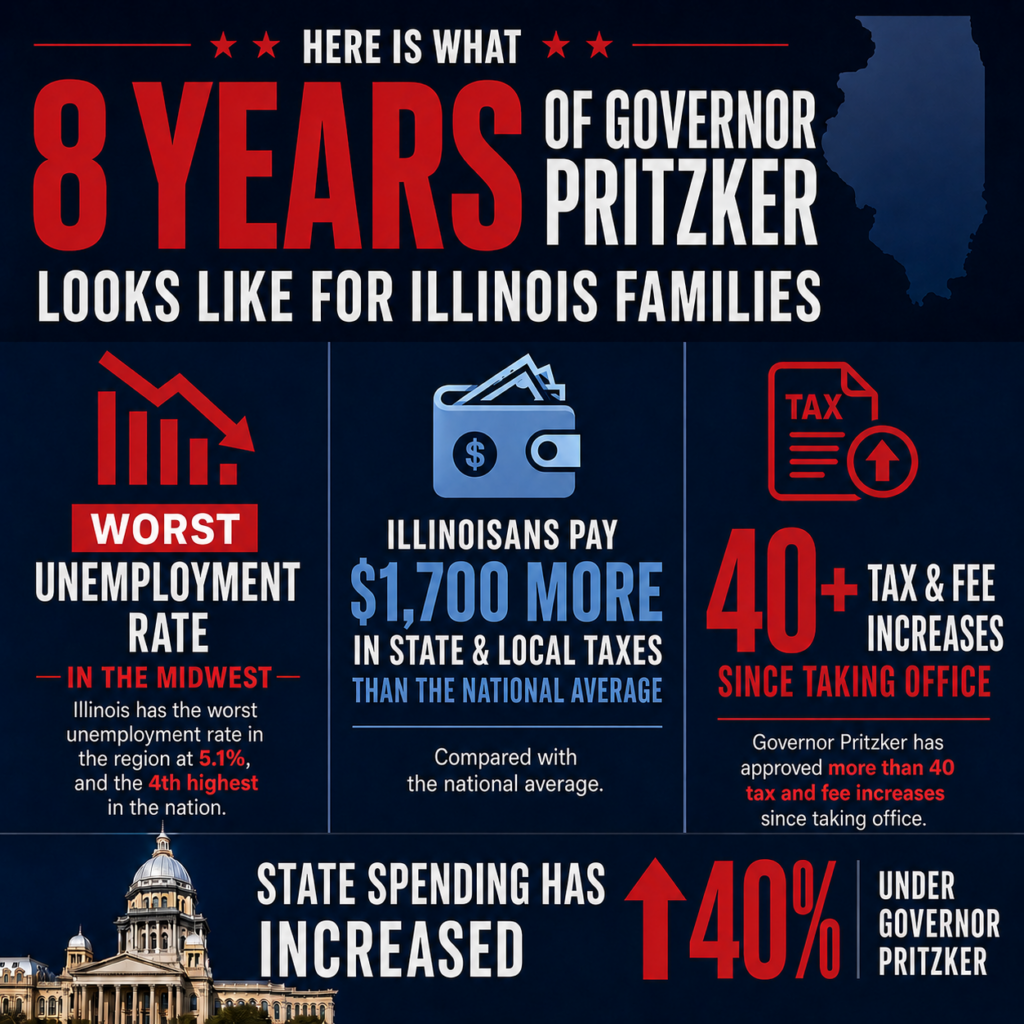
Since 2019, state spending has grown by nearly 40 percent, increasing from roughly $40 billion when he took office to nearly $56 billion for the next fiscal year.
Despite record levels of spending, Illinois continues to face some of the highest taxes and costs in the nation. Illinoisans pay nearly $1,700 more in state and local taxes than the national average, and Governor Pritzker has approved more than 40 tax and fee increases since taking office.
Property taxes remain among the highest in America, while important education reimbursement programs and funds earmarked for municipalities continue to be underfunded. These sweeps from local funding budget allocations create additional pressure on local school districts and taxpayers.
Energy costs also remain a growing concern. In the downstate Ameren territory, electricity prices have increased by more than 150 percent since 2019, while in this region, ComEd customers are expected to see another steep increase in monthly electric bills this summer.
Additionally, economic indicators continue to lag behind neighboring states. Illinois currently has the highest unemployment rate in the Midwest and has experienced the lowest job growth among neighboring states since 2019.
The new budget relies on approximately $800 million in new revenues, taxes, fees, fund sweeps, and revenue enhancements. Included in the budget is the redirection of approximately $150 million in sales tax revenue generated by higher gas prices, which aligns with roughly $150 million in government spending on programs and services for non-citizens.
Illinois families deserve meaningful relief from high taxes, rising utility bills, and increasing costs of living rather than continued growth in government spending.
As the new fiscal year begins on July 1, lawmakers say taxpayers will continue asking whether nearly 40 percent growth in state spending has translated into meaningful improvements for Illinois families.
Democrats’ Tax Hikes Keep Coming as Transit Tax Increase Moves Forward
Hours after Illinois Democrats pushed through more than $800 million in new taxes, another tax increase quietly advanced in the Chicago region.
On June 1, the Regional Transportation Authority (RTA) approved a new 0.25 percentage point sales tax increase for northeastern Illinois. The increase is scheduled to begin August 1 and is expected to generate roughly $553 million on the backs of people visiting and living in Chicagoland, including those in the 32nd District.
The tax hike was made possible under last year’s transit legislation, Senate Bill 2111, which created the new Northern Illinois Transit Authority (NITA) and set the stage for replacing the RTA with a new governing board. That new board is expected to take office on September 1. As you may recall, I voted against this bill.
The timing is telling. On the same day Democrats were advancing hundreds of millions of dollars in additional taxes to fund their ballooning state budget, another Pritzker-approved tax hike from last year was being put into motion quietly and with little fanfare.
What this means for families, commuters, and visitors to the Chicago region is higher sales taxes starting this summer. This is just another example of how Governor Pritzker and his Democrat allies continue answering Illinois’ biggest problems with higher taxes.
Wilcox Summer/Fall Events Calendar Offers Something for Everyone

Now that we’re back in our home districts for the summer and early fall, my legislative team and I are putting the finishing touches on a comprehensive list of outreach events across the 32nd District. Please mark your calendars for the following events:
- June 22: Mobile DMV in Antioch
- June 30: Mobile DMV in Cary
- July 8: Conversations Untapped in Antioch
- July 22: ICASH/Unclaimed Property in McHenry
- July 29: ICASH/Unclaimed Property in Fox Lake
- August 6: Barks & Brews Pet Adoption in Woodstock
- August 8: Document Shredding and Food Collection in Woodstock
- August 13: Property Tax Exemptions Seminar in McHenry
- August 25: IPASS on Demand Sticker Event in Lindenhurst
- September 10: IPASS on Demand Sticker Event in Woodstock
- October 14: Senior Fair in Crystal Lake
- October 25: Veterans Appreciation Luncheon in Lake Zurich
You can learn more about these events on the Events page of my website or by contacting Abby from my events staff at amccarthy@sgop.ilga.gov.
Legislation to Increase Transparency on Utility Bills Passed Unanimously
Illinois consumers will soon have a clearer understanding of the fees and surcharges included on their monthly utility bills, thanks to legislation that passed the Senate unanimously.
House Bill 5524 requires the Commission on Government Forecasting and Accountability (COGFA) to compile information on electric utility fees and surcharges and make that information publicly available in a clear and accessible format.
Under the legislation, information regarding charges collected through electric utility bills will be compiled and reported, including identifying amounts that are remitted to the state and amounts retained by utilities. The goal is to provide consumers with a clearer picture of how their utility bills are structured and where their money is going.
House Bill 5524 now heads to the Governor’s desk for his signature.
Transparency, Veterans Recognition Measures Advance to Governor’s Desk
Legislation to improve government transparency and another to help recognize the service of veterans in Illinois have passed both chambers of the Illinois General Assembly. I supported both measures.
House Bill 2137 requires local governments, counties, and municipalities with existing public websites to provide and post information on how to access audit and financial reports through the Illinois Comptroller’s Office. This legislation is intended to help make it easier to review financial information and to view how local government entities are managing their resources.
Republican lawmakers also advanced House Bill 4385, legislation that allows eligible veterans and military honorees to receive a second set of military-specific plates under the same terms as the first set.
Both measures now await the Governor’s signature.